
Part 1
Guardians of the Islands – Part 1
Releases September 6, 2026
Prologue: The Forgotten Gift
Before the islands had names, they slept beneath the sea.
The ocean covered everything from horizon to horizon, blue above and black below. No palms bent in the trade winds. No birds crossed the empty sky. No drum had learned the rhythm of a human hand.
Then the sea lifted its children toward the light.
Stone rose first. Coral followed. Sand gathered in pale crescents while mangroves reached their roots into the shallows and held fast. Rain filled hollows. Seeds arrived inside birds and storms. Green spread over gray until the islands seemed less like land newly born and more like something ancient remembering its shape.
The first people called the land Mother because it held them.
They called the sea Father because it carried them.
Each year, when the waters changed and the sailing season began, they returned to the shore with gifts. Fruit for the soil. Fish for the tide. Songs for everything that could not be held in two hands.
The custom survived long after its meaning began to fade.
Offerings became ceremonies. Ceremonies became festivals. Children learned the dances before they learned the promises beneath them. Merchants hung bright banners above their doors and offered discounts in honor of powers they no longer believed were listening.
Still, the islands remembered.
The sea remembered.
And there was another presence in the old stories, though later generations disagreed about its name. It moved between breath and storm, invisible until it touched something else. Some elders left a place for it beside the offerings. Others warned that certain names became invitations when spoken aloud.
Most people forgot both traditions.
Thirteen years ago, the air above Ole Sayle Port became still.
Not calm.
Still.
For three days, smoke rose in straight columns. Sails hung useless from their masts. Birds abandoned the harbor. The sea flattened until it reflected the sky without a single broken line.
On the fourth morning, every bell in the port began ringing at once.
No hand touched them.
The storm arrived before anyone could ask why.
Wind tore roofs from houses and carried fishing boats into the market. Waves crossed the quay, filled the streets and climbed stairways that had never known salt water. Families tied themselves together with rope. Sailors who had crossed oceans begged the land to hold.
The storm searched Ole Sayle Port for an entire day.
Near the eastern quay, someone lost a child’s hand.
The child remembered cold water. She remembered fingers slipping from hers. She remembered a voice singing beneath the roar.
Then a wall of water rose above the harbor.
It should have erased the port.
Instead, the wind stopped.
The wave collapsed in place. Water struck the streets without the force that had lifted it. The storm vanished so quickly that doors continued slamming after the air became still.
At sunrise, the survivors thanked the land beneath their feet and the sea for returning those it had spared.
No one asked what had stopped the wind.
No one noticed the child beneath the broken docks, listening to four notes that no one else could hear.
Thirteen years passed.
Ole Sayle Port rebuilt itself in brighter colors. The Festival of the First Tide returned with drums, dancers and boats dressed in ribbons. The people brought offerings to the shore. They sang old songs with forgotten words.
And far beyond the harbor, something answered.
Chapter 1: The Fortune Beneath the Docks
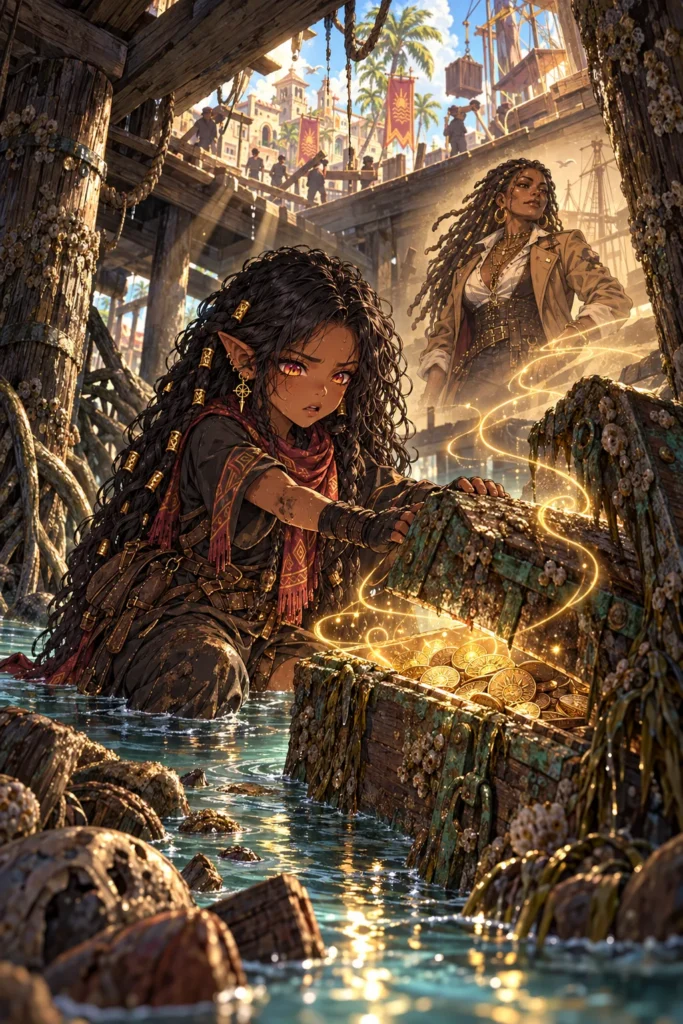
Ole Sayle Port raised children the way it raised stray dogs.
It fed us when scraps were plentiful, kicked us when business was poor and expected gratitude whenever it remembered we existed.
I learned early not to complain.
The port had survived pirates, fires, outbreaks, crooked governors and merchants who believed a signed document made theft respectable. It had little sympathy left for a girl with pointed ears and no family name.
I was seven when the great storm struck.
At least, that was the age Marla Bain later guessed. I had no memory of a birthday and no parents left to correct her.
The storm tore through the islands for an entire day before ending without warning. One moment, the wind was ripping roofs from houses and driving the sea through the streets.
The next, everything became still.
Not calm.
Still.
There was a difference.
Calm felt peaceful.
The silence after that storm felt like something had stopped to listen.
At sunrise, Ole Sayle Port looked as though the sea had tried to swallow it and changed its mind.
Fishing boats rested in the market. Pieces of roof floated between the piers. Nets, barrels and broken furniture covered the shore. One merchant’s house had been lifted from its foundation and placed in the middle of a road, where he immediately began charging people to walk around it.
The port respected initiative.
The survivors searched the wreckage for family, food and anything valuable enough to rebuild their lives.
I searched for breakfast.
No one knew where I had come from.
A fisherman claimed he found me clinging to an overturned door near the eastern quay. A washerwoman insisted I had crawled from beneath a collapsed inn. One sailor swore the tide had carried me into the harbor inside a wooden chest.
Sailors improved every story after the second drink.
I remembered cold water.
I remembered someone holding my hand.
I remembered losing it.
Everything else had been taken by the storm.
My dark skin and pointed ears made the people of Ole Sayle Port certain that I belonged somewhere else. They agreed on that more easily than they agreed on where.
Some called me a Darken.
Others used less generous names.
A few whispered that I had brought the storm with me.
Children repeated what frightened adults said behind closed doors. They threw pebbles at me and asked whether my people lived underground. One boy pulled my ear to see whether the point was real.
I broke his finger.
That did not improve my reputation.
The islands welcomed anyone with coin, cargo or useful relatives.
I had none of those things.
The first morning after the storm, I wandered through the harbor with an empty sack over my shoulder, collecting anything that might be traded for food.
A coil of rope.
Two sealed bottles.
A knife with half its handle missing.
None was worth much, but together they might buy several meals if I found a merchant willing to forget that I was young, alone and easy to cheat.
The tide had not completely withdrawn. Dark water surged between the pilings, carrying splintered wood and tangled seaweed beneath the docks.
That was when I heard the song.
At first, I mistook it for someone singing beneath the harbor.
The melody had no words. It was soft and low, almost hidden beneath the creaking piers and retreating water. Three notes rose together, followed by a fourth that seemed to come from somewhere much farther away.
I looked around.
Workers shouted to one another as they cleared the wreckage. Sailors dragged boats from the streets. Women called the names of missing relatives.
No one else appeared to hear the music.
The song came again.
Three notes.
Then a fourth.
I felt it behind my ribs.
It pulled me toward an abandoned section of the northern docks where the boards had rotted long before the storm. Adults warned children away from the place. Loose nails, unstable beams and nesting cave snakes made it dangerous.
That also made it private.
I climbed down between two barnacle-covered pilings and lowered myself into the shallow water.
The song grew stronger.
I did not hear it with my ears.
Not exactly.
It moved through my bones.
A line of pale shells rested across the wet sand. The storm should have scattered them in every direction, but they formed a crooked trail beneath the collapsed pier.
I followed.
Cold mud pressed between my fingers. Something brushed against my ankle.
I refused to look back.
If it had teeth, I would learn soon enough.
The shells ended beside a wall of mangrove roots that had no business growing beneath the harbor.
The song came from behind them.
I pushed the roots aside.
A wooden chest waited in the mud.
It was small enough for me to wrap both arms around it and heavy enough to resist every attempt to move it. Green metal reinforced its corners. Strange markings covered the lid.
Curling waves surrounded the shape of a crown.
Or perhaps it was a tree.
The roots held the chest like fingers.
I grabbed its handle and pulled.
Nothing happened.
I planted both feet in the mud and pulled harder.
The roots tightened.
Or perhaps I imagined they did.
“Fine,” I muttered. “Keep it.”
I turned away.
The song stopped.
A root snapped behind me.
Then another.
When I looked back, the chest was free.
That should have frightened me.
Hunger was louder than fear.
I dragged the chest into a narrow shaft of sunlight and forced open the lid.
Gold stared back at me.
Coins filled the chest nearly to the top.
They were larger than the currency used in Ole Sayle Port and far heavier. Each one carried the same markings as the lid: curling waves upon one side and the crown-shaped tree upon the other.
The song filled me.
Every coin carried one part of it.
Hundreds of notes joined together, not loud but deep enough to make my bones tremble. It sounded like the sea moving beneath the earth.
I picked up one coin.
The metal felt warm despite the cold water surrounding me.
The note inside it changed.
For one moment, I heard a woman humming.
The voice felt familiar.
Almost remembered.
Then it vanished into the larger song.
I filled both pockets before stopping myself.
Taking everything would attract attention. A strange child could not begin spending ancient gold without someone asking where it came from.
Merchants would cheat me.
Thieves would follow me.
The harbor watch might decide that protecting the treasure required taking it away.
People became remarkably concerned about ownership whenever someone poor found something valuable.
I removed four coins.
One could buy food. Another might be traded for a proper knife. The remaining two would stay hidden in case the first plans failed.
Never spend everything.
The song softened when I closed the chest.
The mud shifted beside the mangrove roots, revealing a hollow almost exactly the right size.
I pushed the chest inside.
Sand slid around it without my help. Within moments, nothing remained except smooth earth.
Even the pale shells had disappeared.
The melody remained.
Faint.
Waiting.
I marked the location by counting the pilings from the ruined staircase and cutting a line beneath one of the beams.
Then I crawled back toward daylight with four ancient coins hidden against my skin.
I told no one what I had found.
There was no one to tell.
For the next few weeks, I slept wherever the harbor watch was least likely to find me. Beneath overturned boats. Inside empty barrels. On the roof of a storehouse whose owner never looked up.
I learned which baker left burnt bread outside his back door and which fish sellers threw away cuts that were still mostly edible. I learned to walk quietly, run quickly and never steal from the same stall twice in one week.
Most importantly, I learned the shape of Ole Sayle Port.
The western docks belonged to fishing crews and smugglers who pretended not to know one another. The eastern quay received merchant ships, naval vessels and travelers who wanted to believe the port was respectable.
The market stood between them.
Everything could be bought there.
Spices. Cloth. Shell jewelry. Information. Forgiveness.
The last two cost more than they were worth.
Beyond the market rose the old town, where brightly painted houses leaned over narrow lanes. Music escaped from open windows. Women shouted conversations between balconies. Children raced through the streets while grandparents watched from shaded porches and claimed not to be watching.
The port was crowded, loud and rarely lonely.
I was lonely anyway.
People knew me.
That was different from belonging.
Market vendors watched my hands whenever I passed. Sailors pulled their purses closer. Mothers called their children inside before I reached their doors.
No one invited me to stay.
I began believing that was better.
Anything given could be taken away.
Anything promised could become a lie.
Then Marla Bain found me stealing from her kitchen.
At the time, the Driftwood Mermaid was little more than a dockside tavern with uneven floors, cheap rum and a roof that leaked in six places.
Marla had marked each leak with a bucket.
The seventh bucket was for anyone who complained.
I entered through a rear window shortly before dawn. The tavern had closed an hour earlier, and I had watched the last drunk stumble into the street.
The kitchen smelled of fried fish, pepper and fresh bread.
I had not eaten since the previous morning.
Hunger made me careless.
I climbed onto a counter, reached for a covered bowl and heard a knife strike the wood between my fingers.
I froze.
Marla Bain stood in the doorway.
She was younger then, though not young. Her hair fell in thick braids around a face that rarely revealed anything without payment. A long knife rested in her hand.
She looked at me.
Then at the fish in the bowl.
“How much were you planning to take?”
The sensible answer was none.
“I had not decided.”
“You climbed through my window without a plan?”
“My plan ended at the food.”
“That is not much of a plan.”
“It was working until the knife.”
Marla entered the kitchen and pulled the blade from the counter.
I considered running.
The window remained behind me.
She stood between me and the door.
I could escape if she reached for me.
Probably.
Marla uncovered the bowl.
“Sit.”
I did not move.
“If I wanted to kill you, child, you would not still be considering the window.”
I sat.
She placed fish, bread and boiled plantain onto a plate. Then she poured water into a chipped cup and set both before me.
“What do you want?” I asked.
“For you to eat before you fall off my table.”
“What do you want afterward?”
One corner of her mouth moved.
“Smarter question.”
I waited.
“Nothing tonight.”
I did not believe her.
I ate anyway.
The food disappeared quickly.
Marla offered more.
I slowed down before accepting. People noticed desperation and charged accordingly.
She watched me finish.
“Name?”
“LuNoir.”
“Family?”
“None.”
“Everyone comes from someone.”
“They are not here.”
Marla did not ask whether they were dead.
That was the first thing I liked about her.
Pity made people look at you as if grief had turned you into something smaller. Marla looked at me as if I were exactly the size I appeared.
“What are you good at?” she asked.
“Leaving.”
“What else?”
“Finding things.”
“Things that belong to you?”
“Sometimes.”
She nodded toward the window.
“Leave through the door. Come back tomorrow after sunset.”
“Why?”
“My storeroom has rats.”
“You want me to catch them?”
“I want you to find where they enter.”
“And then?”
“Then we discuss payment.”
I returned the next evening.
Not because I trusted her.
The bread helped.
I found three holes behind the rum barrels, one beneath the pantry shelves and a loose floorboard leading into the alley. Only the last had been used by rats.
The others had been used by Marla’s employees.
By sunrise, she knew who had been stealing from her storeroom.
I received two copper coins and another meal.
That was how our relationship began.
Not with kindness.
With work.
Marla never offered to become my mother. I never asked.
She gave me errands that required small hands, quick feet and a face most respectable people preferred not to notice. I carried messages between ships, counted crates and listened outside rooms where men spoke too freely.
Sometimes she paid in coin.
Sometimes in food.
During storms, she allowed me to sleep in the storeroom.
She called it protecting the rum.
I understood.
Years passed.
The Driftwood Mermaid grew.
Marla bought the building beside it, then the warehouse behind that. The cheap tables were replaced. Musicians began competing for the right to perform there. Merchants who once ignored her began using her private rooms for meetings.
People started calling her Quicksand.
Some said it was because anyone who fought her only sank deeper.
Others claimed enemies disappeared beneath beaches she controlled.
I never asked which story was true.
Questions could damage a useful relationship.
Marla was not warm.
She was dependable.
In Ole Sayle Port, that was rarer.
She taught me how to recognize a false coin by its weight and a liar by the moment he chose to smile. She showed me how to hide a knife where a guard would not search and how to enter a room as though I belonged there.
“People see what they expect,” she told me. “Give them something familiar to look at.”
“What do they expect from me?”
“A thief.”
“That is convenient.”
“Only if you decide what they fail to notice.”
She was the only person who spoke to me as if being an outcast did not make me less human.
Marla valued my speed, my memory and my ability to enter places where I had not been invited. She treated those things as skills I possessed rather than proof that I was born untrustworthy.
I did not want that to change.
She was also the only person who noticed the song.
She discovered the truth when I was twelve.
We stood inside a warehouse filled with sealed crates from a confiscated vessel. Marla had purchased the cargo without being allowed to inspect it.
She asked which crate contained something valuable.
I pointed toward one in the corner.
“You did not open it,” she said.
“No.”
“You did not read the shipping list.”
“I cannot read that handwriting.”
“How do you know?”
The crate sang beneath the others.
Three soft notes.
Then a fourth.
“I hear it.”
“Hear what?”
“A song.”
Marla’s expression did not change.
“From the crate?”
“From whatever is inside.”
She opened it.
Beneath two layers of cheap cloth rested a ceremonial mask covered in gold and blue stones.
Marla stared at it for a long time.
Then she closed the lid.
“Does all gold sing?”
“No.”
“Jewels?”
“Sometimes.”
“What makes the difference?”
“I do not know.”
That answer annoyed her.
Marla disliked mysteries she could not sell.
She tested me for months.
Coins, relics and shipwrecked cargo passed through the Driftwood Mermaid. Some sang. Most remained silent. The objects that carried the melody were always old. Older than the families claiming to own them. Many bore waves, crowns, trees or spirals.
Marla made me promise never to reveal what I heard.
“People will use you,” she said.
“You are using me.”
“Yes.”
Her honesty was refreshing.
“The difference is that I pay.”
She did.
Whenever my song identified something valuable, my share appeared before I asked. She never cheated me in the ways I could prove.
I began working for her regularly.
The treasure chest remained beneath the northern docks. I visited it only at night and never took more than I needed. Marla knew the song existed. She did not know where its clearest voice slept.
Some secrets protected people.
Others protected the way they looked at you.
By sixteen, I knew every rooftop, alley and hidden quay in Ole Sayle Port. I could carry a message from one end of the harbor to the other without the watch seeing me.
I slept in a room above Marla’s western storeroom.
It had one window, a narrow bed and a lock on the inside.
It was the closest thing I had to a home.
Marla remained the closest thing I had to family.
I never called her that.
She never asked me to.
We understood one another better through the things we refused to say.
She did not tell me how many smugglers worked for her.
I did not tell her that a lost fortune slept beneath her docks.
Thirteen years after the great storm, the Festival of the First Tide returned to Ole Sayle Port.
The streets filled with dancers, drums and visitors from every island. Boats crowded the harbor beneath bright banners. Vendors sold shell crowns while elders prepared offerings for the land and sea.
That morning, Marla summoned me to the private room above the Driftwood Mermaid.
She stood beside an open window, watching the festival.
A small package waited upon the table.
Black wax sealed its wrapping.
The symbol of a sinking crown had been pressed into it.
“You have a delivery,” she said.
“To whom?”
“A merchant at the eastern quay. Red sash. Beside the spice warehouse.”
“What is inside?”
“Not your concern.”
Usually, that answer ended the discussion.
I approached the table.
Then I heard the song.
It came from inside the package.
Three low notes.
Then a fourth.
The same melody I had first heard beneath the docks.
But something was wrong with it.
The notes scraped against one another. The rhythm dragged. Beneath the familiar song, something whispered like sand moving across glass.
Marla watched my face.
“You hear it.”
It was not a question.
“What did you find?”
“For once, LuNoir, nothing that belongs to us.”
She pushed the package across the table.
The black wax felt warm beneath my fingers.
Something shifted inside.
Dozens of tiny grains scraped against the wrapping.
I secured my shortbow beneath my coat and settled the narrow quiver against my back. Marla had taught me never to advertise a weapon, especially when everyone expected a knife.
“Deliver it unopened,” she said. “Then return before sunset. Big Tom is hosting the First Tide music competition tonight, and I expect every table in the Mermaid to be full.”
“You expect trouble?”
“I expect customers. Trouble rarely needs an invitation.”
The song followed me as I left the Driftwood Mermaid.
It grew louder with every step toward the festival.
For thirteen years, the treasure beneath the docks had waited in silence.
Now something had begun singing back.
0 views